
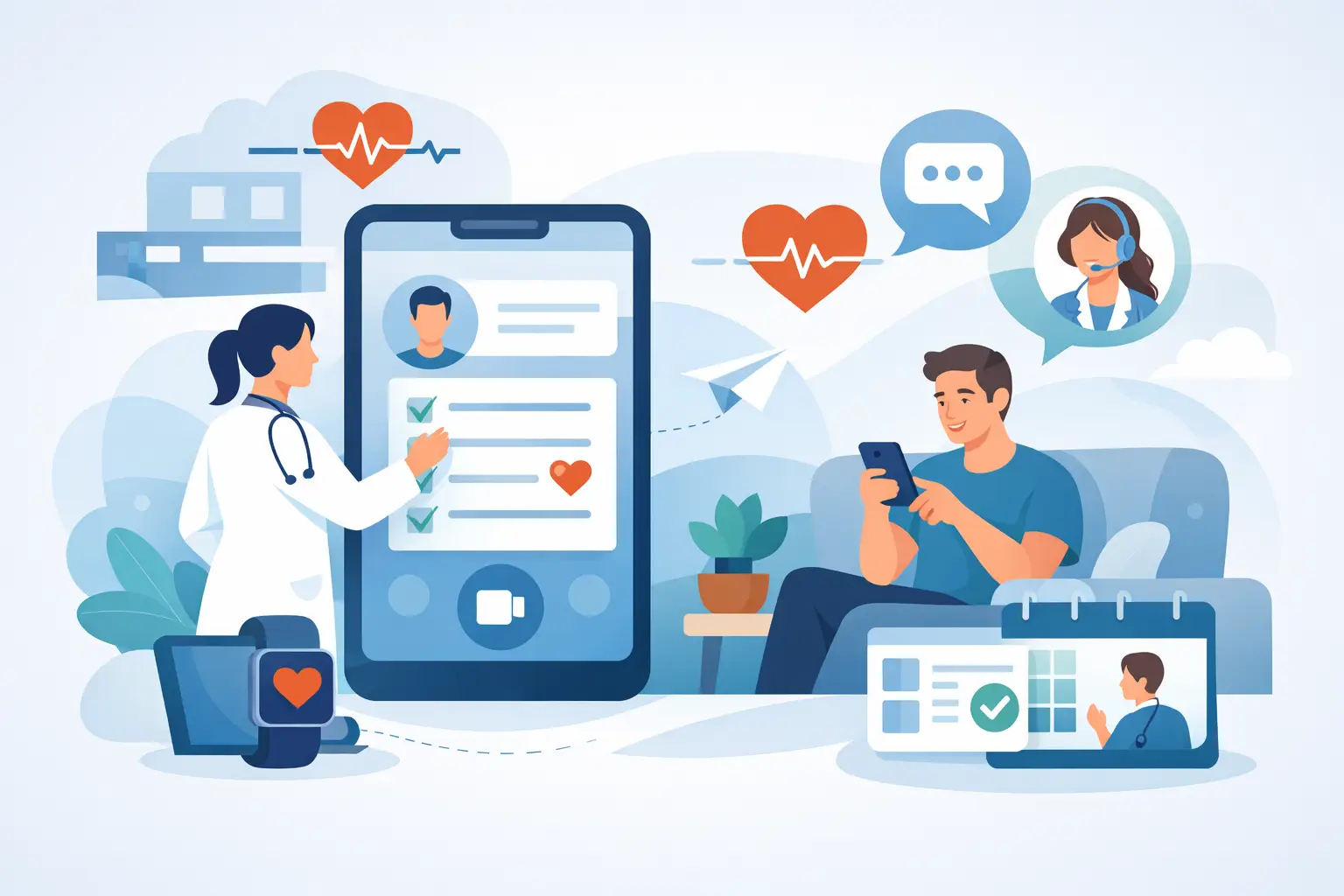
A patient engagement app review should begin where most software demonstrations end: with the real patient journey. A polished interface and a long feature list do not guarantee that a patient will schedule an appointment, complete pre-treatment steps, understand discharge instructions, or return for follow-up care. For hospitals and clinics, the right app must improve access and trust while producing measurable operational and commercial results.
This matters even more for international patient programs. A patient considering treatment abroad may need records reviewed, a treatment plan explained, travel coordinated, payments clarified, and post-treatment questions answered across time zones. An app can reduce friction in that process, but only when it fits the provider’s clinical workflows, contact center operations, and patient acquisition strategy.
What a Patient Engagement App Should Actually Do
Patient engagement is often treated as a collection of digital features: appointment reminders, secure messaging, educational content, forms, and video consultations. Those functions are useful, but their value depends on the outcome they support.
For a local clinic, the priority may be reducing no-shows and shortening the time between inquiry and booked consultation. For a hospital group, the app may need to support service-line campaigns, referral management, and patient retention. For a medical tourism provider, it may need to create confidence before travel and maintain continuity after the patient returns home.
A high-performing engagement app helps patients take the next appropriate step without forcing them to repeat information or search for answers. It should also give teams the context needed to respond quickly. If a patient has submitted imaging, requested a treatment estimate, and spoken with a coordinator, that history should inform the next conversation.
The strongest platforms therefore connect engagement with operations. They do not sit apart from the CRM, contact center, electronic health record, or sales process. They help teams identify which leads need attention, which patients have not completed required tasks, and where a journey is losing momentum.
Patient Engagement App Review: Evaluate the Full Journey
A useful review looks beyond the app store rating or vendor claims. It assesses the platform at each stage of the patient relationship: acquisition, consultation, treatment preparation, care delivery, aftercare, and re-engagement.
Start with the moment of inquiry
The first test is speed and clarity. Can a prospective patient request information, submit records, select a preferred contact method, and receive a realistic next step? If the app asks for too much information before offering value, it may reduce conversion. If it offers only generic information, it may fail to move a high-intent patient toward consultation.
For international patients, the experience should address the questions that influence trust: physician credentials, hospital accreditation, treatment scope, estimated timelines, travel requirements, and support after the procedure. An app should guide the patient without making clinical promises that require physician review.
Providers should also examine lead handoff. An inquiry is not engaged simply because it appears in a dashboard. The platform must route the patient to the right coordinator, trigger appropriate follow-up, and capture the source of the lead. Without that connection, marketing teams cannot accurately assess which campaigns produce qualified consultations and booked treatments.
Review communication quality, not just message volume
Messaging is central to engagement, but more notifications are not better. Patients quickly ignore repeated, poorly timed, or irrelevant alerts. Review whether the app supports targeted communication based on treatment stage, language preference, location, and patient action.
A patient who has not confirmed an appointment needs a different message from someone preparing for surgery. A patient arriving in Turkey for treatment may need logistics and coordinator contact details. A patient recovering at home may need symptom guidance, follow-up scheduling, and a clear route to clinical support.
Two-way communication is equally important. Patients should be able to ask questions through approved channels, while teams need escalation rules for urgent concerns. An app cannot replace clinical judgment or emergency services. It should clearly state those boundaries and direct patients to appropriate care when a situation requires immediate attention.
Check whether education reduces uncertainty
Education is a major opportunity and a common weakness. Many platforms provide content libraries that are difficult to search, too technical, or disconnected from a patient’s treatment plan. Effective education is concise, relevant, and delivered when it is needed.
A bariatric surgery patient may need information on pre-operative nutrition, expected recovery, and follow-up milestones. A dental implant patient may need guidance on treatment phases, temporary restorations, and travel timing. The best app experiences organize this material around the actual pathway rather than asking patients to navigate a generic resource center.
Content also needs clinical governance. Hospitals should define who approves patient-facing information, how updates are tracked, and how medical claims are reviewed. This protects patient trust and supports consistent communication across coordinators, physicians, and marketing teams.
The Operational Requirements Behind Patient Adoption
An app can only improve engagement if staff use it consistently. Before selecting a platform, evaluate the daily work required from physicians, nurses, patient coordinators, call center agents, and marketing teams.
Integration is usually the deciding factor. If coordinators must copy information from the app into a CRM, then into a scheduling system, and then into clinical records, delays and errors will follow. The right level of integration depends on the organization, but core patient identity, appointment status, consent records, communications, and task completion should not live in disconnected systems.
Privacy and security deserve equal scrutiny. A platform handling protected health information should support appropriate access controls, audit trails, secure data storage, consent management, and role-based permissions. International programs must also consider how cross-border data handling affects their operations. Legal and compliance teams should review the vendor’s practices before patient data is uploaded or shared.
Language support is another practical issue. Translation alone is not enough for global patient engagement. Dates, costs, care instructions, and consent language must be clear for the intended audience. Where clinical interpretation is required, the app should support a process that protects accuracy rather than relying on automated text alone.
Measure Results That Matter to Leadership
A patient engagement platform should be reviewed against a defined business case. Adoption rates matter, but they are only the beginning. A high download rate has limited value if patients still abandon forms, miss appointments, or call repeatedly for basic information.
Leadership teams should establish a baseline before launch and monitor performance after implementation. The most relevant measures typically include inquiry-to-consultation conversion, appointment confirmation rates, no-show rates, time to first response, pre-treatment task completion, treatment acceptance, and patient satisfaction. For international programs, it is also useful to track record submission completion, travel readiness, arrival rates, and post-treatment follow-up adherence.
Revenue attribution requires care. An app may assist a conversion without being the only reason a patient booked treatment. Rather than claiming credit for every patient who used the platform, assess how engagement changes the performance of defined patient segments. Compare response times, completion rates, and sales outcomes for patients who use key workflows against those who do not.
This approach gives executives a more credible view of return on investment. It also identifies where the app needs improvement. If patients open reminders but fail to complete intake forms, the issue may be form length, unclear instructions, mobile usability, or a missing human support option.
Common Trade-Offs When Choosing a Platform
There is no universally best patient engagement app. A feature-rich enterprise system may meet complex hospital requirements but require a longer implementation, more training, and higher internal ownership. A simpler solution may launch quickly and perform well for scheduling and messaging, yet offer limited customization or reporting.
Custom app development can be the right choice when a provider has a distinctive patient pathway, particularly in medical tourism. It can reflect the organization’s care model, language needs, brand standards, and sales workflows. However, customization also creates ongoing responsibilities for maintenance, security updates, integrations, and product decisions. A custom build should be justified by clear operational needs, not by the desire to have a branded app.
Vendor support is another factor that deserves direct questions. Ask how implementation is managed, what training is included, how service issues are handled, and whether the vendor understands healthcare consent, clinical communication, and international patient coordination. Generic customer engagement expertise is not always enough in a healthcare setting.
Build the App Around a Human Care Team
The most effective patient engagement strategy combines technology with accountable people. Patients value digital convenience, but they also want knowledgeable guidance when decisions are personal, expensive, or clinically complex. A well-designed app gives coordinators more time for those conversations by reducing repetitive administrative work and making patient information easier to act on.
For provider organizations, the goal is not simply to deploy another channel. It is to create a more reliable path from first inquiry to informed treatment decision and long-term follow-up. DGS Healthcare approaches that path as both a growth and patient experience challenge, aligning digital tools with acquisition, conversion, and care coordination.
Choose the platform that makes the next right action clearer for the patient and easier for the team. That is where engagement becomes trust, and trust becomes a stronger care relationship.
Related guides

Patient Experience That Drives Trust and Growth
A patient who has already uploaded medical records, compared providers, and arranged time away from work is not…

What Is a Medical Travel Facilitator and Why Use One?
A lower treatment quote can look compelling until you try to compare what it actually includes: surgeon fees,…

What Hospital Accreditation Reviews Really Tell You
A hospital can have polished facilities, prominent surgeons, and hundreds of five-star ratings, yet those signals do not…