
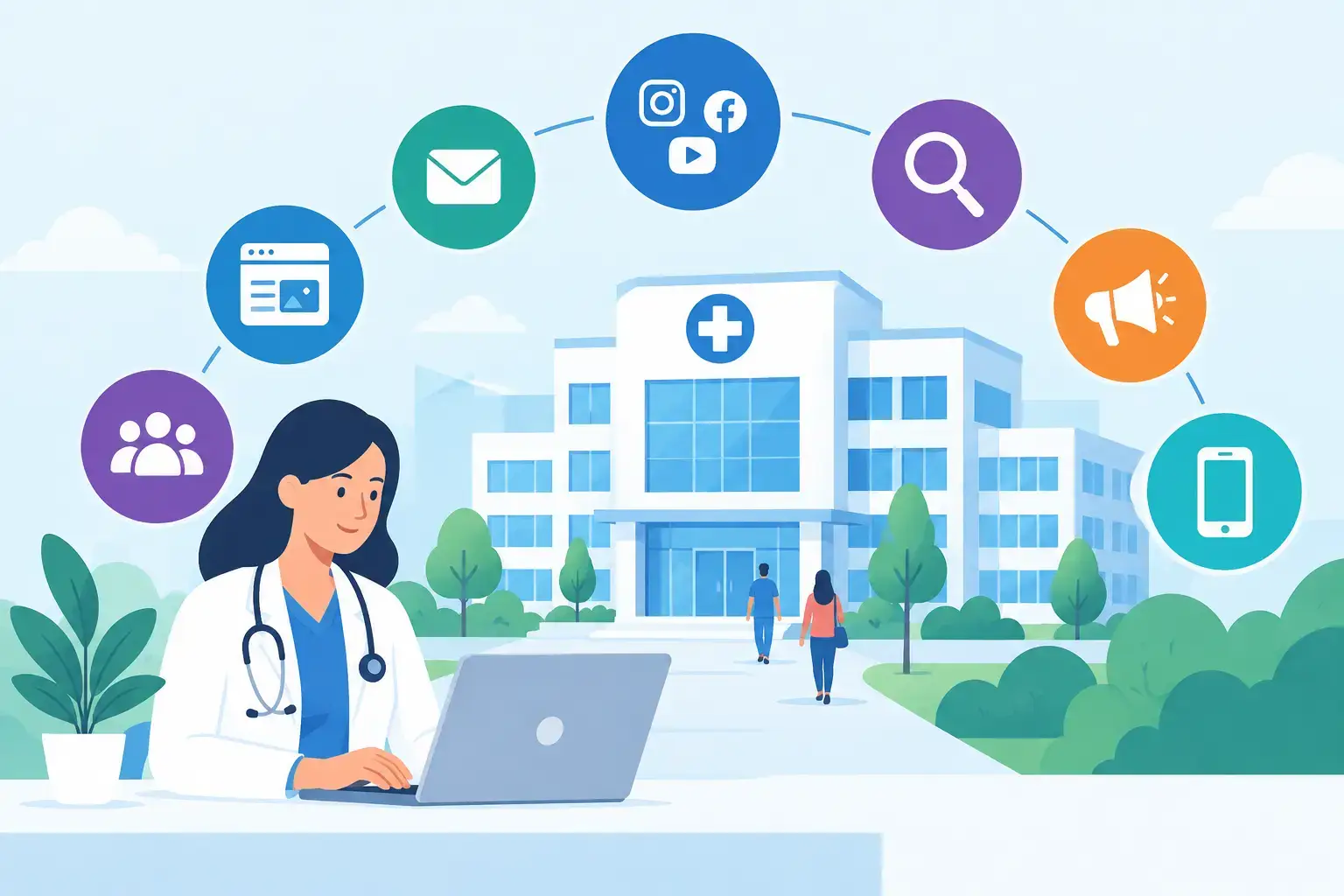
A hospital can generate thousands of impressions and still miss its growth target if those impressions do not become qualified inquiries, scheduled consultations, and completed treatments. The top healthcare marketing channels for hospitals are not simply the channels with the largest reach. They are the channels that connect the right service line, patient need, market, and follow-up process at the moment a patient is ready to act.
For hospital executives, marketing directors, and international patient departments, the question is not whether digital visibility matters. It does. The commercial question is where to invest first, how to measure performance beyond leads, and how to ensure every inquiry receives a timely, credible response.
How Hospitals Should Select Marketing Channels
Channel selection should begin with the economics of a service line. A high-value procedure such as bariatric surgery, orthopedics, oncology, fertility treatment, or robotic surgery can justify a more intensive acquisition model than a low-margin outpatient service. The patient’s decision cycle also matters. Emergency care depends heavily on location and local reputation, while elective procedures often involve weeks of research, comparison, financing questions, physician evaluation, and family input.
Hospitals should assess each channel against four commercial measures: qualified inquiry volume, consultation booking rate, treatment conversion rate, and revenue or contribution margin per acquired patient. Cost per lead alone can be misleading. A low-cost lead that cannot be reached, does not meet clinical criteria, or cannot afford treatment is not a growth result.
For international patient acquisition, trust carries additional weight. Patients considering treatment abroad need evidence of clinical quality, physician expertise, accreditation, care coordination, travel support, transparent pricing, and aftercare planning. The most effective channel mix makes those answers easy to find and reinforces them at every touchpoint.
Top Healthcare Marketing Channels for Hospitals
Search Engine Optimization and AIO
Search engine optimization remains one of the strongest long-term channels for hospitals because it captures patients actively seeking answers. A prospective patient searching for a knee replacement hospital, IVF success considerations, or affordable cardiac surgery is already signaling intent. Hospitals that provide credible, medically reviewed content can earn visibility before a patient submits an inquiry form.
The strategy should go beyond broad treatment pages. Build content around the full decision path: symptoms and treatment options, physician credentials, procedure eligibility, recovery expectations, cost considerations, hospital capabilities, and destination logistics for international patients. Location-specific content is particularly valuable when hospitals want to reach patients in priority markets.
AIO, or optimization for AI-driven answer experiences, should support this work. Clear page structure, accurate clinical information, direct answers to common questions, authoritative physician profiles, and consistent hospital data help increase the chance that content is surfaced in answer engines. It is a longer-term investment, and results are not immediate, but it creates a durable source of high-intent demand.
Paid Search for Immediate Patient Demand
Paid search is often the fastest way to generate measurable demand for priority procedures. It enables hospitals to appear when potential patients search for treatment, specialist, cost, or destination-related terms. This makes it especially effective for service lines with clear patient value and a sales team prepared to respond quickly.
The strength of paid search is control. Campaigns can be segmented by procedure, geography, language, device, and patient intent. A hospital may use one campaign for local orthopedic consultations and another for international patients researching cosmetic surgery or dental restoration packages.
The trade-off is cost and competition. Broad medical terms can consume budget without producing viable cases. Strong campaigns use tightly organized keyword groups, clinically appropriate landing pages, clear qualification questions, and conversion tracking that follows a lead through consultation and treatment. If the call center cannot respond within minutes during operating hours, paid search efficiency will suffer.
Physician-Led Video and Social Media
Patients do not choose hospitals based on logos alone. They want to understand who will treat them, what the facility is like, and whether the care experience feels credible. Video and social media give hospitals a practical way to humanize clinical expertise without compromising professional standards.
Short physician videos can address common concerns about procedures, candidacy, recovery, and technology. Facility tours, patient journey explanations, and multilingual educational content can also reduce anxiety for international audiences. The goal is not viral entertainment. It is trust-building content that moves a patient from uncertainty to a consultation request.
Social platforms are generally stronger for awareness, retargeting, and relationship building than for immediate high-value conversions. Results improve when social activity is connected to a defined service line, a clear call to action, and a reliable pathway into a patient coordinator or consultation team.
Reputation Management and Patient Reviews
For many patients, reviews are the final checkpoint before contacting a hospital. A sophisticated website cannot compensate for unanswered concerns, inconsistent ratings, or a visible pattern of poor communication. Reputation management is therefore a core acquisition channel, not a public relations afterthought.
Hospitals should establish a compliant process for requesting feedback from appropriate patients, monitoring review platforms, responding professionally, and escalating operational issues that appear repeatedly. Responses should never disclose protected health information or become defensive. They should demonstrate accountability, empathy, and a commitment to resolving concerns.
International patients also look for proof that a provider can manage the entire journey. Reviews that mention coordination, interpreter support, airport transfers, clear communication, and post-treatment follow-up can be as persuasive as comments about clinical outcomes.
Email, CRM, and Patient Nurture Campaigns
Not every qualified prospect is ready to book immediately. Some need medical records reviewed, financing clarified, travel dates coordinated, or reassurance from a family member. Email and CRM workflows keep the conversation moving during this period, provided communication is timely and relevant.
A useful nurture sequence should reflect where the patient is in the decision process. A new inquiry may need a clear introduction to the hospital and next steps. A patient awaiting a treatment plan may need information about the physician, expected timeline, and required documentation. A patient who received a quote may need help understanding inclusions, travel planning, or payment options.
CRM infrastructure also gives leadership a clearer view of leakage. It can reveal how many leads were contacted, how long response took, why cases were lost, and which source produced the highest-value treatments. DGS Healthcare treats this operational visibility as part of marketing performance because acquisition and conversion cannot be separated.
Call Centers and Telesales
A hospital’s call center is often the channel where marketing investment is either protected or wasted. Patients who submit a form after researching a serious procedure expect a knowledgeable response, not a generic callback days later. For international programs, the first conversation must often address medical documentation, pricing expectations, safety, travel, and timing at once.
High-performing teams use defined contact standards, multilingual support where needed, clinical escalation paths, and structured follow-up. They track more than call volume. Key measures include speed to lead, contact rate, consultation booking rate, show rate, treatment conversion, and reasons for non-conversion.
Telesales is particularly valuable for elective treatments and medical tourism programs with longer consideration cycles. It should be consultative rather than aggressive. Patients need guidance from people who understand both the treatment journey and the hospital’s capabilities.
Referral Partnerships and Medical Tourism Networks
Partnership marketing can provide hospitals with high-quality demand that is difficult to reach through advertising alone. Referring physicians, employer health programs, insurers, facilitators, diaspora organizations, and international care coordinators may all play a role, depending on the hospital’s market and service lines.
For hospitals serving medical travelers, partnerships work best when the patient handoff is transparent and the experience is tightly managed. Partners need confidence in clinical standards, response times, pricing clarity, and the hospital’s ability to support patients before and after travel. A referral source can create meaningful volume, but overreliance on one partner creates commercial risk. Balance partner acquisition with owned demand channels such as search, content, and CRM.
Build a Channel Mix Around the Patient Journey
The strongest hospital marketing strategies do not treat channels as isolated campaigns. Search content may introduce a patient to a procedure. Paid search may capture an urgent inquiry. Video may establish confidence in the physician. A coordinator’s call may convert interest into a consultation. CRM follow-up may support the decision until treatment is scheduled.
That journey requires shared reporting across marketing, international patient services, call centers, and finance. Hospitals should review performance by procedure, source market, physician, and patient stage, then shift investment toward channels that create profitable treatments rather than superficial activity.
Start with the service lines where your hospital can deliver clear clinical and commercial differentiation. Build a patient experience that answers difficult questions quickly, then let every channel lead patients toward the same reliable next step: a well-managed conversation with a team prepared to help.
Related guides

7 Top Medical Travel Destinations for U.S. Patients
For U.S. patients facing high out-of-pocket costs, long wait times, or limited access to a specialist, the top…

How to Improve International Patient Onboarding
An international patient inquiry is not simply a lead. It is often a person making a high-stakes decision…

Treatment Abroad Financing Guide for US Patients
A lower treatment quote abroad can be compelling, but the number on a hospital estimate is rarely the…