
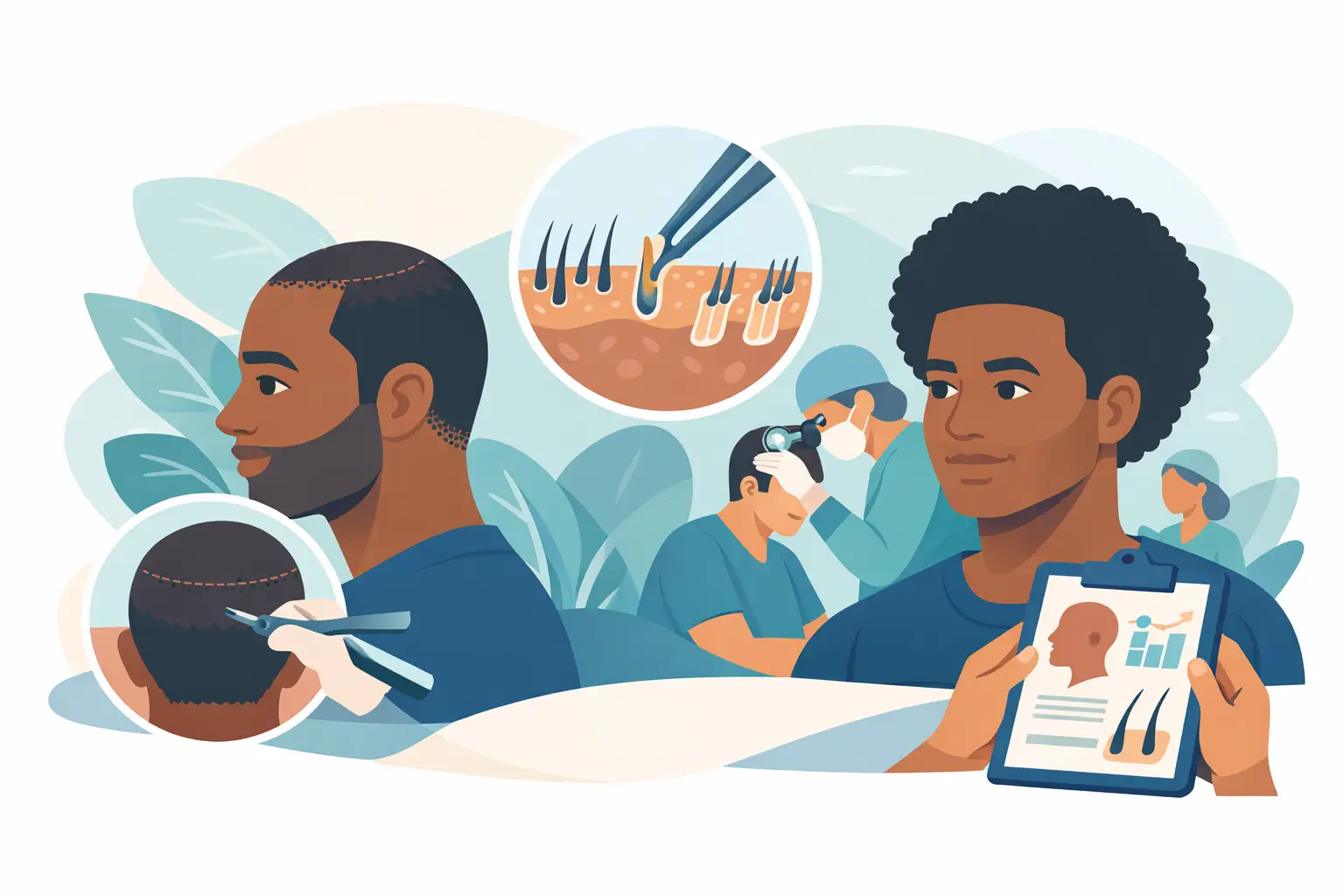
Most hair transplant advice is written as if all hair behaves the same. It does not. An afro hair transplant requires a different level of planning because tightly curled hair has unique characteristics above and below the scalp. That affects graft extraction, angle design, density planning, healing, and ultimately the final result.
For patients, this is not a small technical detail. It is often the difference between a natural-looking outcome and a procedure that falls short. For clinics and international patient programs, it is also a reminder that afro-textured hair restoration should never be marketed as routine work. It demands experience, case selection, and clear expectations from the first consultation.
Why afro hair transplant cases are different
Afro-textured hair tends to curl not only on the surface but also within the follicle under the skin. That curved follicle path makes graft extraction more challenging than it is with straight hair. If a surgeon uses a standard approach without adjusting for that curvature, the risk of follicle transection goes up, meaning healthy grafts can be damaged during removal.
That technical challenge is one reason surgeon selection matters so much. A clinic may offer hair transplantation broadly, but that does not automatically mean it has consistent experience with afro-textured hair. The instruments, punch choice, extraction angle, and pace of the procedure may all need to be adjusted.
There is also a visual difference that works in the patient’s favor. Afro-textured hair can create the appearance of stronger coverage because the curl adds volume and helps disguise scalp visibility. In practical terms, this can mean good cosmetic improvement without needing the same graft count that a patient with very straight hair might require. Still, that does not mean every patient is a candidate for aggressive density. Donor capacity, hairline design, and long-term hair loss pattern still matter.
Choosing the right technique for an afro hair transplant
The two most discussed methods are FUE and FUT. In afro hair transplant cases, both can be appropriate, but the best option depends on the patient’s goals, scalp characteristics, and the surgical team’s expertise.
FUE for afro-textured hair
FUE removes individual follicular units one by one. Many patients prefer it because it avoids a linear scar and can offer a faster return to daily activities. However, with tightly curled follicles, FUE can be technically demanding. The surgeon needs to follow the true curve of the follicle beneath the skin, not just the visible direction of the hair shaft.
When done well, FUE can produce excellent results in afro-textured hair. When done poorly, graft damage can be high, and donor area management can become a problem. That is why patients should look beyond marketing claims and ask how often the clinic performs FUE on afro-textured hair specifically.
FUT in selected cases
FUT involves removing a strip of donor scalp and dissecting grafts under magnification. In some afro hair transplant patients, this can reduce the challenge of blind extraction through curved follicles. It may also be useful when a larger number of grafts is needed or when preserving donor quality is a priority.
The trade-off is the linear scar and a different recovery profile. Some patients will accept that compromise for graft quality. Others will not. There is no universal winner here. The best technique is the one that fits the anatomy, hairstyle preferences, and long-term plan.
Hairline design matters as much as graft survival
Patients often focus on graft numbers, but design is where natural results are won or lost. Afro-textured hairlines should reflect facial proportions, age, ethnicity, and styling habits. A hairline that is too sharp, too low, or too uniform can look artificial even if the grafts grow well.
Curl pattern helps create softness and fullness, which can make a hairline look natural without overpacking the front. That is useful, especially when donor supply is limited. At the same time, experienced surgeons know that temple work, transitions, and directional placement are critical. It is not only about placing hairs. It is about placing them in a way that matches how afro-textured hair naturally emerges and frames the face.
The donor area deserves a realistic conversation
Some patients assume that if the transplant area is small, the donor side is simple. That is not always true. In afro-textured hair, the donor area can be more vulnerable to visible overharvesting if extraction is not carefully distributed. The surgeon must protect donor appearance while preserving enough grafts for future needs.
This is especially important in younger patients or in men with progressive androgenetic alopecia. A strong result today should not create limitations tomorrow. Hair loss usually continues, and a responsible treatment plan accounts for that. Medical therapy may also be part of the conversation, depending on the cause of hair loss and the patient’s overall health profile.
What to ask before booking treatment abroad
Medical tourism can make high-quality hair restoration more accessible, particularly when patients are comparing US pricing with treatment in destinations like Turkey. The value can be significant, but the right decision is never about price alone.
Patients considering treatment abroad should ask direct, specific questions. Who performs the extraction and recipient site creation? How many afro-textured hair cases has the surgeon completed? Are before-and-after results available for patients with a similar hair type? What is the clinic’s policy if fewer grafts are safely achievable than originally estimated?
It also helps to understand the full care pathway. Travel support, airport transfers, hotel planning, interpreter services, medication guidance, and follow-up coordination all affect the patient experience. A well-managed process reduces stress and limits the kind of confusion that can happen when care is fragmented across multiple vendors. This is where a structured medical travel partner such as DGS Healthcare can add value by helping patients navigate provider selection and treatment logistics with greater confidence.
Recovery and aftercare are not side issues
Aftercare has a direct impact on results. The first days after surgery require careful washing, sleeping position adjustments, and avoidance of friction or trauma to the grafted area. Patients with afro-textured hair may also need individualized guidance on when to resume common grooming routines, including close cutting, braiding, or the use of styling products.
One common concern is shock loss, where transplanted or surrounding hairs shed before new growth begins. This can be normal, but it still causes anxiety if patients are not prepared for it. Growth takes time. Early healing and graft retention are not the same thing as final density. Most patients need patience over several months before they can assess the true outcome.
Clinics that handle international cases well do not disappear after the procedure. They maintain a follow-up plan, review healing progress, and give the patient a clear route for asking questions after returning home. That support is not a luxury. It is part of safe care.
Red flags patients should take seriously
If a clinic avoids discussing the difficulty of afro-textured hair extraction, that is a warning sign. If every patient is quoted the same graft number, that is another. If the consultation feels rushed or the team relies on generic before-and-after photos without matching hair type and hair loss pattern, caution is warranted.
The same goes for unrealistic promises. No ethical provider can guarantee perfect density, stop future hair loss, or ignore donor limitations. Good clinics are persuasive because they are clear, not because they overpromise.
Cost, value, and the question patients really mean to ask
When patients ask, “How much does an afro hair transplant cost?” they are usually asking something broader: what am I really paying for, and what are the odds of getting a result worth the trip?
The answer depends on more than a package price. Surgical skill, graft handling, anesthesia standards, facility quality, aftercare, and revision risk all shape value. A lower upfront cost can become expensive if the result is weak or the donor area is compromised. By contrast, a well-executed procedure from a qualified team may provide lasting cosmetic and psychological benefit.
For many patients, the smartest move is not chasing the cheapest quote. It is choosing a provider with credible experience in afro-textured hair, transparent planning, and a care model that continues after the flight home.
Hair restoration is personal, but it should never feel like guesswork. When the anatomy is respected, the technique is matched to the patient, and the planning is honest, an afro hair transplant can deliver results that look natural and age well. The right clinic will not just sell the procedure. It will help you make a sound decision before a single graft is touched.
Related guides

Healthcare Content Compliance Guide for Growth
A high-performing treatment page can generate international patient inquiries within hours. It can also create material risk if…

Turkey Hospitals vs Local Hospitals Compared
A lower procedure quote can get a patient’s attention. It should not make the decision on its own.…

Patient Experience That Drives Trust and Growth
A patient who has already uploaded medical records, compared providers, and arranged time away from work is not…