
An international patient inquiry rarely arrives at a convenient time. A prospective patient in Chicago may submit a request for a dental implant consultation while a hospital’s team in Istanbul is offline. By the time someone responds, that patient may have contacted three other providers. Marketing automation helps healthcare organizations respond with speed and structure while keeping the patient experience personal, informed, and trustworthy.
For hospitals, clinics, and medical tourism programs, automation is not simply a way to send more emails. It is an operating system for moving qualified demand from first inquiry to consultation, treatment planning, travel coordination, and follow-up. When designed around real patient decisions, it can improve conversion rates, reduce missed leads, and give leadership a clearer view of commercial performance.
What Marketing Automation Means in Healthcare
Marketing automation uses connected technology to trigger relevant communications and internal actions based on a person’s behavior, needs, and stage in the patient journey. A patient who requests information about bariatric surgery, for example, should not receive the same sequence as someone researching IVF, cosmetic dentistry, or orthopedic care.
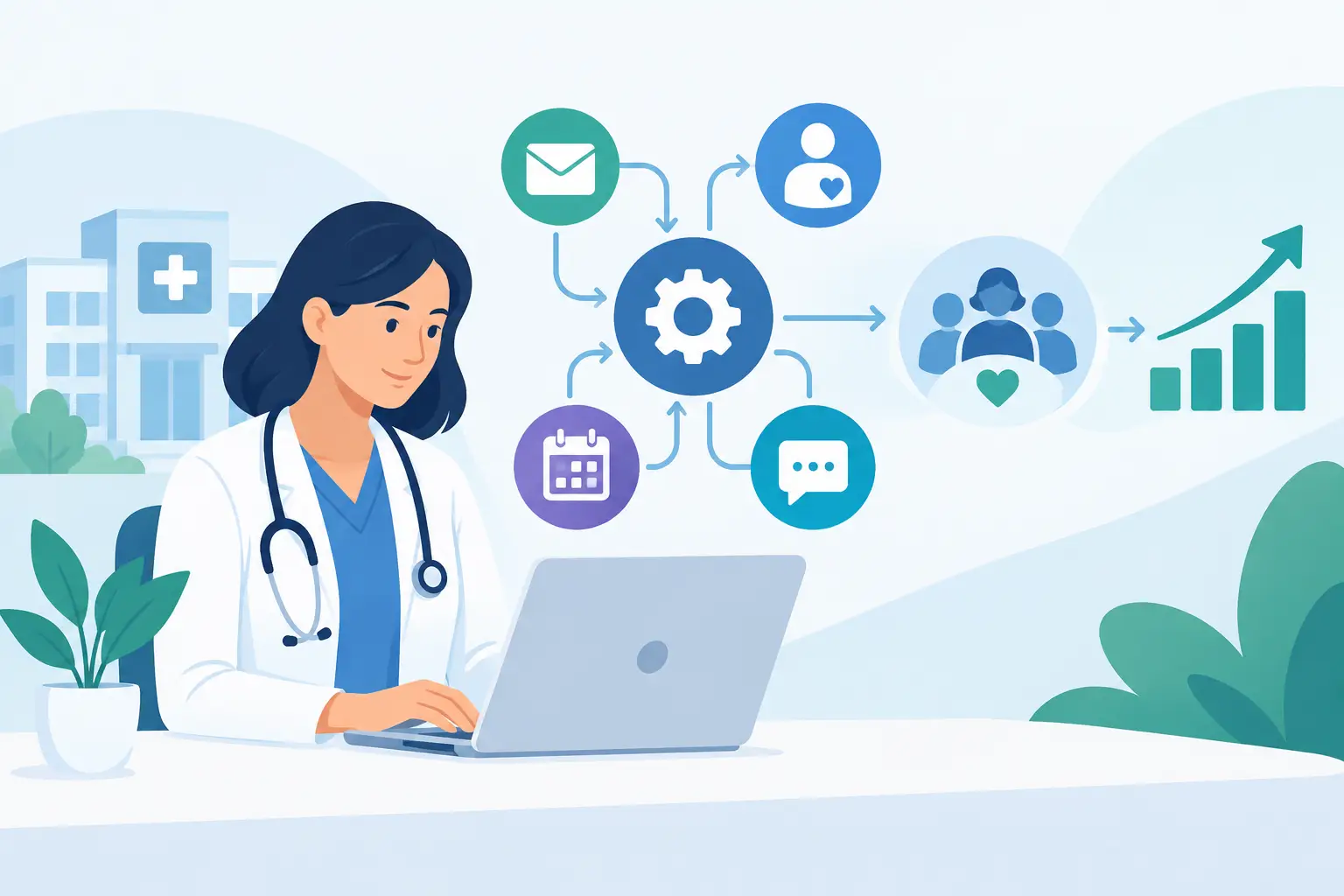
The technology can capture a form submission, assign the lead to the appropriate international patient coordinator, send a prompt acknowledgment, create a CRM record, notify a call center team, and begin a tailored follow-up sequence. The purpose is not to replace the coordinator. It is to ensure that no serious inquiry waits in a generic inbox and no patient has to repeat critical information at every step.
In healthcare, the standard must be higher than in retail or general B2B marketing. Communications need to be accurate, respectful, consent-based, and aligned with privacy obligations. Automation should support clinical credibility and informed decision-making, not pressure a patient into care.
Where Automation Creates Commercial Value
The strongest programs focus on the points where revenue leakage is most common: delayed response times, incomplete lead records, inconsistent follow-up, and weak handoffs between marketing, sales, and patient coordination teams.
Faster first response without a generic experience
Speed matters, especially in competitive international treatment markets. An automated response can confirm receipt immediately, explain the next step, and set expectations for a consultation. It can also ask for the information needed to move forward, such as medical records, preferred travel dates, budget expectations, or a phone number for a coordinator.
That message should feel like the start of a guided process, not an automated sales blast. It should identify the care pathway, provide a realistic response window, and reassure the patient that a qualified team will review the request. For high-intent leads, automation can trigger an urgent task or call alert so a human team member follows up quickly.
Better lead qualification and routing
Not every inquiry has the same potential or urgency. A clinic may receive leads from patients who are ready to schedule, people gathering early-stage pricing information, referral partners, and inquiries outside its treatment scope. Without a structured system, sales teams spend too much time sorting leads manually and qualified patients receive inconsistent attention.
Lead scoring can prioritize patients based on meaningful signals: treatment requested, destination preference, submitted medical documentation, requested callback, estimated travel window, and engagement with care information. The score should guide action, not become an unexplained black box. A patient with a complex clinical need may deserve immediate attention even if their digital activity is limited.
Routing is equally important. Cosmetic surgery inquiries may go to one team, oncology second-opinion requests to another, and domestic leads to a local admissions workflow. Clear routing protects response time and ensures patients speak with staff who understand the service line, language needs, and required documentation.
Consistent follow-up across a longer decision cycle
Medical tourism decisions often take weeks or months. Patients compare hospitals, assess physician credentials, discuss care with family, consider financing, and plan time away from work. A single call or quote rarely closes the journey.
Automation makes sustained follow-up practical. A patient who has requested a treatment plan but has not replied can receive a thoughtful reminder. Someone who reviews information about a hospital can be invited to a consultation. A patient with a confirmed treatment date can receive pre-travel instructions, document reminders, and arrival guidance.
The cadence should reflect the procedure and the patient relationship. A high-consideration surgery requires educational, confidence-building communication. A short elective treatment journey may call for a more direct scheduling sequence. Frequency should be controlled carefully. Too many reminders can weaken trust, particularly when a patient is dealing with a sensitive health issue.
Stronger visibility from lead source to treatment revenue
Many healthcare organizations can report website traffic and form fills but cannot confidently connect marketing investment to consultations, bookings, completed procedures, or patient lifetime value. That gap makes budget decisions difficult and allows inefficient channels to continue consuming spend.
When marketing automation is connected to a CRM, call center, and reporting framework, leadership can follow the full path. They can see which campaigns produce qualified inquiries, which countries generate the highest consultation rates, where leads stall, and how quickly teams respond. They can also compare performance by service line, coordinator, language, and acquisition source.
This is where automation becomes a growth discipline rather than a software purchase. The relevant question is not how many workflows are active. It is whether the system helps the organization acquire the right patients profitably and deliver a better service experience.
Building a Healthcare Marketing Automation Framework
A practical implementation starts with the patient journey, not the platform. Before creating any email sequence or scoring model, map what happens from the first point of contact through treatment and aftercare. Identify who owns each stage, what information is required, and where delays or lost opportunities occur.
Next, establish a clean data foundation. Contact records should capture only information that is necessary for marketing and coordination, with clear consent practices and controlled access. Duplicate records, missing lead sources, and inconsistent treatment categories make reporting unreliable and prevent useful personalization.
The CRM should then define shared lifecycle stages. For example, an organization may distinguish between a new inquiry, contacted lead, qualified consultation, treatment plan issued, booked patient, treated patient, and post-treatment follow-up. Marketing, call center, and international patient teams must use the same definitions. If one department calls a lead qualified while another calls it uncontacted, automation will amplify confusion rather than solve it.
Once the foundation is ready, start with a small number of high-impact workflows. The best first candidates are usually immediate inquiry acknowledgment, missed-call follow-up, consultation reminders, incomplete form recovery, treatment-plan follow-up, and pre-travel communications. These workflows address known operational gaps and produce measurable results quickly.
DGS Healthcare approaches this work as part of a connected patient acquisition and sales operation. The technology matters, but so do lead response standards, call center execution, conversion-focused content, and a reporting model that holds every stage accountable.
The Boundaries That Protect Patient Trust
Healthcare automation has limits. It should not be used to provide individualized medical advice without appropriate clinical review, promise outcomes, or make patients feel monitored. Automated content must be reviewed for clinical accuracy, and patient communications should make it easy to reach a real person.
Privacy requirements also vary by market and by the information being processed. Hospitals serving US patients need to evaluate how protected health information is handled, who can access it, where it is stored, and whether marketing consent has been properly obtained. Legal and compliance teams should be involved early, particularly when systems integrate forms, call recordings, messaging tools, and third-party platforms.
There is also a human trade-off. A highly automated operation can become efficient but impersonal if staff treat workflow completion as a substitute for meaningful conversation. The goal is not to automate reassurance. It is to give patient coordinators better context, faster alerts, and more time to provide reassurance when it matters most.
Measuring What Actually Improves Growth
Open rates and clicks can offer useful signals, but they are not the primary measures of healthcare growth. A stronger dashboard tracks speed to first contact, contact rate, qualification rate, consultation attendance, treatment-plan acceptance, booking rate, cost per booked patient, and revenue by source.
For international programs, measure operational milestones too: medical records received, visa or travel readiness, deposit completion, arrival rate, and post-treatment satisfaction. These metrics show where patient intent turns into operational friction. They also reveal whether marketing is attracting the right audience for the provider’s capabilities.
Automation performs best when it is reviewed regularly. A workflow that worked well for one market may underperform in another because of language, payment expectations, travel distance, or cultural preferences. Testing is valuable, but only when changes are judged against patient quality and booked care, not vanity metrics.
The right automation program should make every patient feel less like a lead and more like a person with a serious decision to make. For healthcare organizations, that is where efficient systems and trusted care can support the same outcome: more patients receiving the right guidance at the moment they are ready to act.
Related guides
Hospital Marketing Attribution That Drives Growth
A hospital can generate thousands of website visits, hundreds of inquiries, and a full calendar of campaigns -…
How to Improve Healthcare Website Conversions
A hospital website can attract thousands of visitors and still produce too few consultations, calls, or international patient…

Can Foreigners Use Turkish Hospitals? What to Know
A sudden illness, a planned surgery, or a long-delayed dental procedure can make one question urgent: can foreigners…